



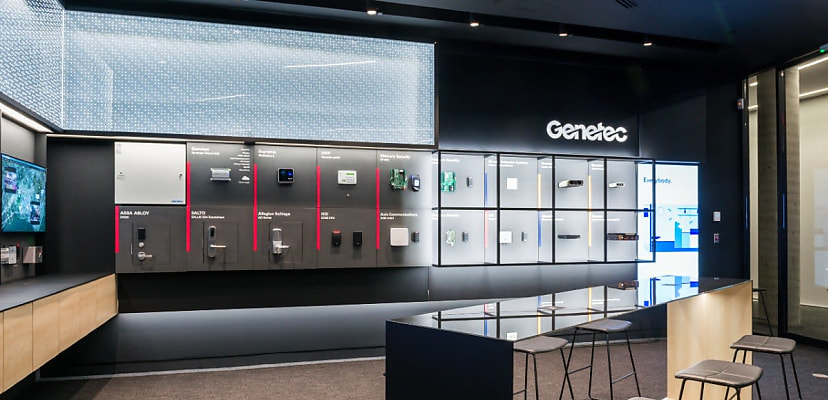
In a glass-lined experience centre outside Montreal, customers can now watch a simulated security intrusion unfold across walls of video, while accessing control dashboards and analytics feeds.
Similar facilities in Sydney, Paris, and, in the next few years, in Saudi Arabia illustrate where Genetec sees its future – not merely as a physical security firm, but as a software company helping enterprises make security a data-driven function.
“We’re in a period of huge disruption,” Andrew Elvish, the Montreal-headquartered company’s vice-president of marketing, said during its 2026 Global Press Summit earlier this month.
That disruption is not just technological. It is reshaping how organisations think about physical security, who buys it, and what they expect from their vendors.
From cameras and doors to platforms and data
Founded in Montreal and now employing around 2,400 people globally, Genetec has quietly become one of the most influential software vendors in the physical security sector. Its core platform, Security Center, unifies video surveillance, access control, automatic number plate recognition, and analytics.
But the company’s evolution mirrors a broader shift: physical security is no longer a hardware problem – it is becoming an enterprise software category that stretches beyond securing entry points and tracking employees.
“Physical security is now seen as a core enterprise focus, an investment not unlike investing in something like Salesforce,” Elvish said.

This reframing is driving wholesale replacement of legacy systems. In Genetec’s latest State of Security report – its sixth edition, based on 7,300 respondents and downloaded more than 11,000 times – 60 per cent of organisations said their primary motivation for replacing systems was integration with newer technologies. Another 51 per cent cited access to new capabilities.
Perhaps most tellingly, IT departments – not security managers – are increasingly driving those decisions.
“IT has become a much bigger player in purchasing intent,” Elvish said.
The cloud transition is accelerating, cautiously
Genetec’s research shows hybrid cloud deployments are growing steadily as organisations update ageing on-premises systems. Automatic updates, easier deployment, and simplified maintenance remain the key attractions.
But full cloud migration remains gradual.
Security infrastructure – often protecting critical facilities such as airports, utilities, and government sites – cannot simply be “lifted and shifted” overnight. Hybrid approaches allow organisations to keep latency-sensitive or mission-critical functions on-prem while moving analytics and management layers to the cloud.
“Hybrid cloud continues to get a little bit bigger, continues to get a little more attractive, as older systems age out,” Elvish said.
AI shifts from curiosity to priority
No technology has risen faster on security buyers’ agendas than artificial intelligence. In Genetec’s report, AI jumped from last place to the second-highest priority in just one year, now ranking alongside traditional pillars such as access control and video surveillance.
“You’d have to be living under a rock not to understand this,” Elvish said.
The interest reflects AI’s potential to transform security operations – from identifying suspicious behaviour to automating investigations and reducing the burden on human operators.
However, that enthusiasm is tempered by caution.
“People are interested in AI in the security space, but they have a lot of questions about how it is being implemented,” Elvish said.
Those concerns range from privacy and ethics to accuracy and regulatory compliance. Genetec has introduced formal policies around responsible AI use, reflecting growing scrutiny of how surveillance technologies are deployed.
Cyber security becomes impossible to ignore
Perhaps the most profound – and uncomfortable – change for the physical security industry is its collision with cyber security.
For decades, physical security systems operated in isolation. Today, they are network-connected software platforms, creating new attack surfaces across the enterprise.
“Physical security still has a challenge in understanding the importance of cyber security,” Elvish said.
“In many ways, people in physical security see cyber security as someone else’s problem.”
That mindset is increasingly untenable.
Regulations such as Europe’s GDPR have already forced change, impacting 40 per cent of manufacturers and integrators surveyed. Meanwhile, customers are scrutinising vendors’ software practices, patching policies, and long-term viability.
Indeed, the single biggest factor influencing vendor selection – cited by 73 per cent of respondents – is long-term stability.
That plays directly into Genetec’s positioning as a privately held, software-centric vendor rather than a hardware manufacturer competing on price.
Global fragmentation shapes local realities
Despite shared technology trends, regional differences remain stark.
Economic uncertainty is delaying projects worldwide, but talent shortages are easing in some regions while intensifying in others. Australia stands out as a particularly constrained market.
“It’s a very competitive market, very resource-restrained,” Elvish said.
“How do we optimise the talent we have?”
Elsewhere, different pressures dominate. Supply chain disruption and inflation remain major concerns across Europe, the Middle East, and Africa (EMEA) and the Asia-Pacific region, while tariffs have emerged as a new anxiety in North America in 2026.
Yet despite those differences, Elvish said the underlying priorities are remarkably consistent.
“Security needs are common across the world,” he said.
Experience centres reflect a changing sales model
Genetec’s new experience centres reflect another industry transformation: security is becoming a strategic investment requiring executive buy-in.
These facilities allow customers to explore integrated security operations in action, reinforcing the message that modern security is less about hardware and more about software, analytics, and operational efficiency.
The decision to build a new Experience Center in Saudi Arabia is particularly significant, highlighting the Middle East as one of Genetec’s fastest-growing markets, driven by large infrastructure projects and national transformation programs.
An industry reinvented
For much of its history, physical security was a fragmented business dominated by hardware manufacturers. Today, it is becoming a software platform market shaped by cloud computing, AI, cyber security, and enterprise integration.
For Genetec, that shift represents both validation and opportunity.
The company has spent years positioning itself as a software-first alternative in an industry defined by proprietary hardware. Now, as customers prioritise integration, cloud flexibility, AI capabilities, and vendor stability, that strategy appears increasingly aligned with market demand.
The biggest challenge may not be technology, but mindset. Physical security is no longer just about protecting doors and cameras. It is about protecting data, operations, and organisations themselves.
 Want to see more stories from trusted news sources?
Make Cyber Daily a preferred news source on Google.
