



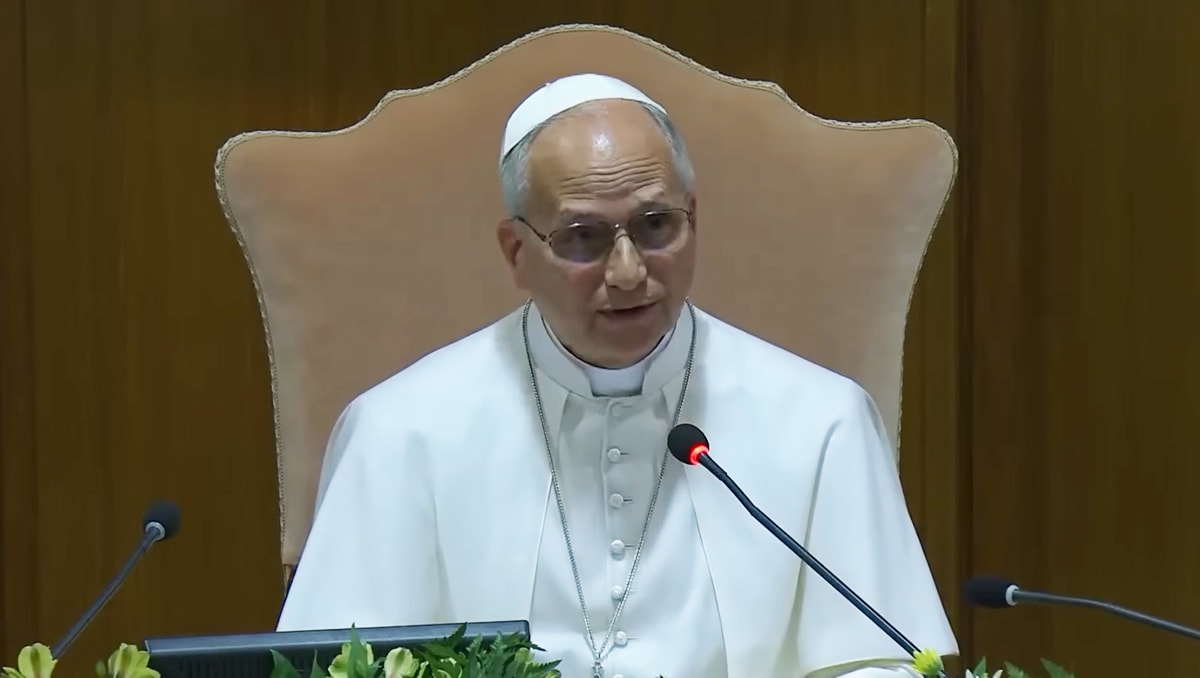
The head of the Catholic Church, Pope Leo XIV, has warned in his first encyclical to the wider church of the dangers of artificial intelligence and its related algorithms being controlled by a technocratic few, arguing that “humanity, created by God in all its grandeur, is today facing a pivotal choice: either to construct a new Tower of Babel or to build the city in which God and humanity dwell together”.
It’s a powerful first line in a document that runs to more than five lengthy chapters, and once the Pope is done establishing the importance of the Church’s Social Doctrine and its principles (the common good, social justice, and human rights), he gets down to addressing the challenge of our time, and its impact on the world: artificial intelligence and how it is creating a dangerous concentration of power.
‘A valuable tool that requires vigilance’
The encyclical’s title hints at the Pope’s general contention: “Magnifica Humanitas: On Safeguarding the Human Person in the Time of Artificial Intelligence”. However, it’s in chapters three and four where the pontiff delivers the encyclical’s defining argument.
Pope Leo addresses both the personal use of AI and how it is being deployed at a structural level, and while he addresses the benefits of the technology, its potential harms are the focus. For instance, when contemplating the use of AI chatbots as potential companions and advisers, Pope Leo said the apparent “words of advice” AI provides have the potential to be “misleading, creating the illusion of a relationship with a real personal subject”.
“The artificial imitation of care or support can become particularly risky when it enters contexts where real relationships and emotional bonds are lacking,” Pope Leo said.
“Here, the danger is not so much that a person may believe they are communicating with another person, but rather that they may gradually lose the very desire to form genuine human connections.”
AI, the Pope contends, is undoubtedly a driver of efficiency and productivity, but these advantages come with a raft of risks that must be addressed, not the least of which is environmental impact, a point that anyone living next to a newly built data centre no doubt understands.

However, it is the concentration of the potential power of AI in the hands of a few powerful individuals and companies that is of just as much concern.
“There are clearly harmful uses, such as the manipulation of information or violations of privacy,” Pope Leo said.
“Yet there is also a subtler danger, for when AI systems present themselves as neutral and objective, they end up reflecting and reinforcing the stereotypes or ideological bias of their designers and developers.”
In one passage, in particular, the pontiff could be referring to Australia’s recent robodebt scandal and the impact it could have on those excluded by a simple algorithm.
“In this process, political responsibility is also lost, not just empathy toward those excluded, which can, after all, be simulated. The exclusion of the vulnerable becomes cloaked in a veneer of neutrality and objectivity, against which it becomes difficult to raise objections,” Pope Leo said.
“In this way, injustice goes unnoticed, and compassion, mercy, and forgiveness – understood not as mere appearances but as real political actions – gradually disappear from view.”
‘Truth and democracy’
With so much power to shape the perceived reality of billions, the encyclical takes direct aim at “those who command powerful technological and economic resources”.
These few, according to Pope Leo, have the power to influence some of humanity’s most basic truths. This is, however, “pure power detached from truth, which subtly or overtly imposes what it wishes others to accept as true”.
“The search for truth is an essential element of democracy, which is itself a means of contributing to the common good,” Pope Leo said.
“When questions about what is true lose their appeal, and a pragmatism takes hold that is content with what appears useful or effective, then democratic life is weakened.”
The issue, according to Pope Leo, is that communication and culture are inseparable, and that what happens in the digital realm is not divorced from that of the “real” world. Subsequently, those who control the digital platforms we use every day, and that now seem so essential, can and do exercise their not inconsiderable power to “affect the collective imagination and to present a particular vision of reality as desirable”.
The Pope is clear on an important point, too, that he is not attempting to either “demonise nor idolise technological tools,” but rather to suggest that they be harnessed towards the “common good” of truth, and not merely as “the property of those with power or influence”.
To counter that influence, Pope Leo lists off better education, tackling AI-driven unemployment, reviving open dialogue and diplomacy, and recognising the inherent value and dignity of honest labour, among a host of other counterweights to the power and influence of a technological elite.
‘We can all do our part’
Against that elite, the Pope said, it may be easy to feel dispirited, and he makes a fine point. It’s hard to argue with the sheer wealth and cultural reach of a figure like Elon Musk, backed by a global platform such as X. Musk can amplify or damn with a single tweet.
But we are not too small, and neither are the problems before us too big for anyone to make a difference.
“There are those who govern, make investment decisions, lead institutions, conduct research, educate, produce or provide information, and then there are those who only seem to live their daily lives,” Pope Leo said.
“Yet, no one is without responsibility. We all have our own areas for action.”
You can read the full encyclical here.
 Want to see more stories from trusted news sources?
Make Cyber Daily a preferred news source on Google.
